GUIDES & FOUNDATIONS · GUIDE 01 · 9 NOVEMBER 2026
What Is Data Readiness—and How Is It Different from AI Readiness?
A practical guide for individuals, entrepreneurs and small businesses.
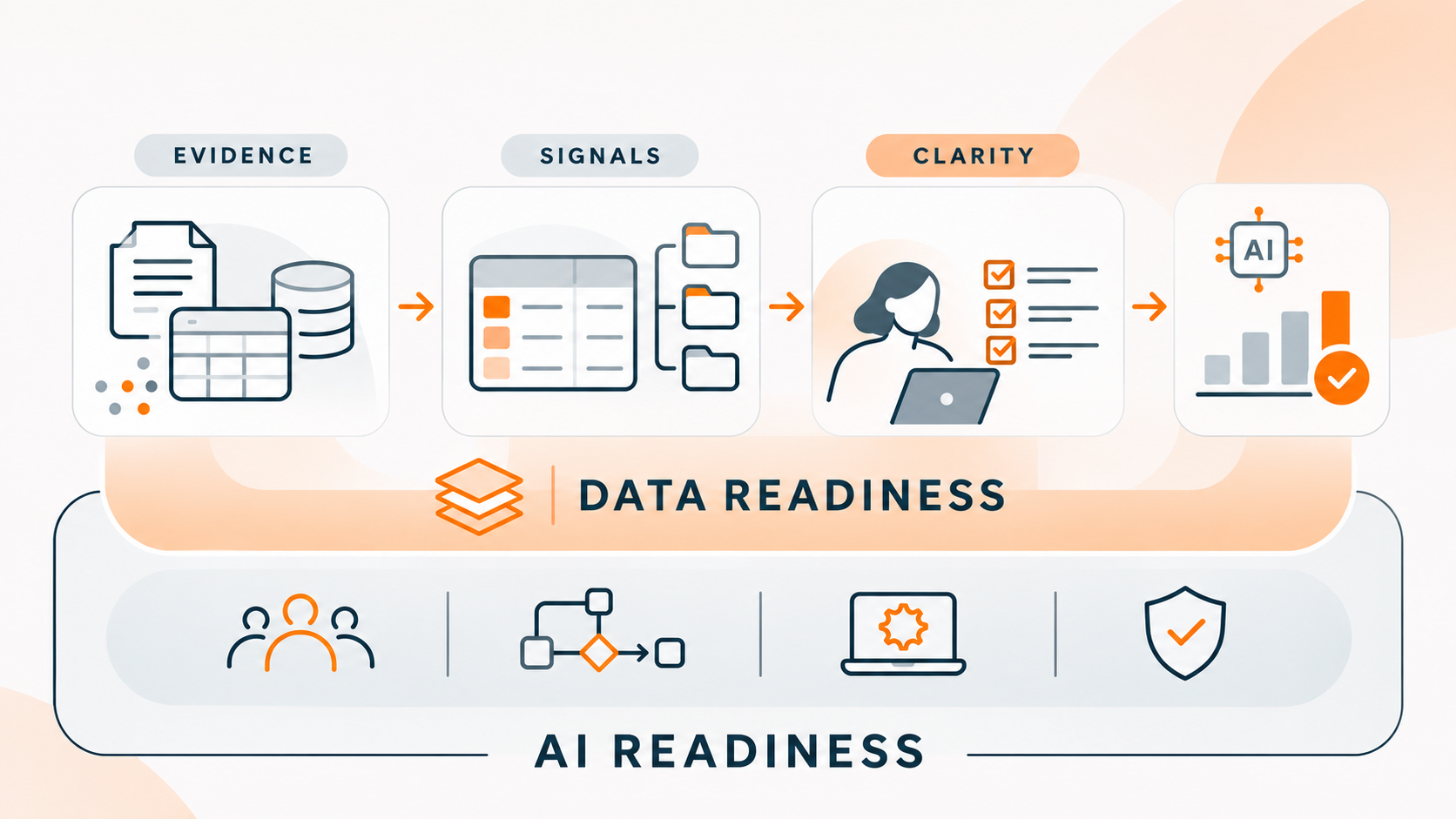
People often start an AI conversation with the same question: “Which tool should we use?” It is a reasonable question, but sometimes it comes too early. Before choosing software, it helps to understand the information, people and processes that the tool would rely on.
That is where data readiness and AI readiness come in. They are related, but they are not the same thing. And importantly, good data readiness can make life easier even if you never use AI.
What is data readiness?
Data readiness means that the information you need is sufficiently reliable, understandable, accessible to authorised people and suitable for a particular purpose.
Data might be a spreadsheet of sales, a list of customers, appointment records, survey answers or a collection of business documents. Having this information is a starting point. Knowing what it means—and whether you can trust and use it—is what matters.
For example, suppose a small shop tracks sales in several spreadsheets. One file calls a product “Blue Shirt”; another calls it “Shirt - Blue”; a third contains returns mixed with sales. The shop has data, but comparing sales across those files may produce misleading results.
Improving data readiness could mean agreeing on product names, separating sales from returns, recording missing dates and documenting where the figures came from. The result is not just tidier spreadsheets. It is information that supports better stock planning, reporting and decisions.
Readiness does not mean perfect data or collecting as much as possible. It means data that is fit for the specific task, with important limitations understood.
What is AI readiness?
AI readiness asks a broader question: Is a person or organisation prepared to use a particular AI tool or system effectively, responsibly and with a clear purpose?
Useful data may be one part of the answer. Other parts include the skills of the people using the tool, how it fits into a workflow, whether outputs can be checked, what it costs, and the privacy, security and oversight needed for the intended use.
A company could have well-organised records but still be unready to use AI to make high-impact decisions. Perhaps nobody has defined who reviews the results, or whether the proposed use is appropriate. Conversely, someone can use an AI assistant to help draft public-facing text without needing a large internal dataset.
So AI readiness is not a single yes-or-no score. It depends on what you want the AI to do and the consequences if it gets something wrong.
The difference in one example
Imagine that the shop wants to forecast which products it should order next month.
The data-readiness questions are: Are past sales recorded consistently? Are returns and discounts treated correctly? Do we know which records are missing? Are the numbers recent enough to be useful?
The AI-readiness questions go further: Would forecasting actually improve ordering? Who will judge whether the predictions are sensible? Can staff explain and challenge them? How will the business test accuracy, handle access to records and decide when not to follow a suggestion?
Cleaning the data alone will not answer every AI question. But buying a sophisticated forecasting tool will not repair unreliable sales records either.
Where should you start?
Start with three practical questions:
1. What decision or task are we trying to improve? Be specific. “Understand our customers better” is broad; “find which products are regularly out of stock” is something you can investigate.
2. What information do we already have? Check what it describes, where it came from, whether it is usable and who is authorised to access it. Do not assume that more data is always better.
3. What would a dependable result require? Decide whether a clear report, a better process, ordinary analytics or an AI tool makes sense. If AI is involved, agree how people will review its outputs and how sensitive information will be protected.
Sometimes the next step is AI. Sometimes it is cleaning a spreadsheet, improving a form, asking a better question or fixing a process. All of those can be progress.
Evidence. Signals. Clarity.
The principle behind data readiness is simple: begin with evidence you can understand, look for useful signals and turn them into clear decisions. AI can strengthen that process, but it cannot replace the need to know what information means or whether it is trustworthy.
You do not have to become an AI expert to begin. You need to know what you want to accomplish—and what you can reliably build on.