GUIDES & FOUNDATIONS · GUIDE 02 · 9 NOVEMBER 2026
Is Your Business Ready for AI?
Five practical questions to ask before investing in another tool.
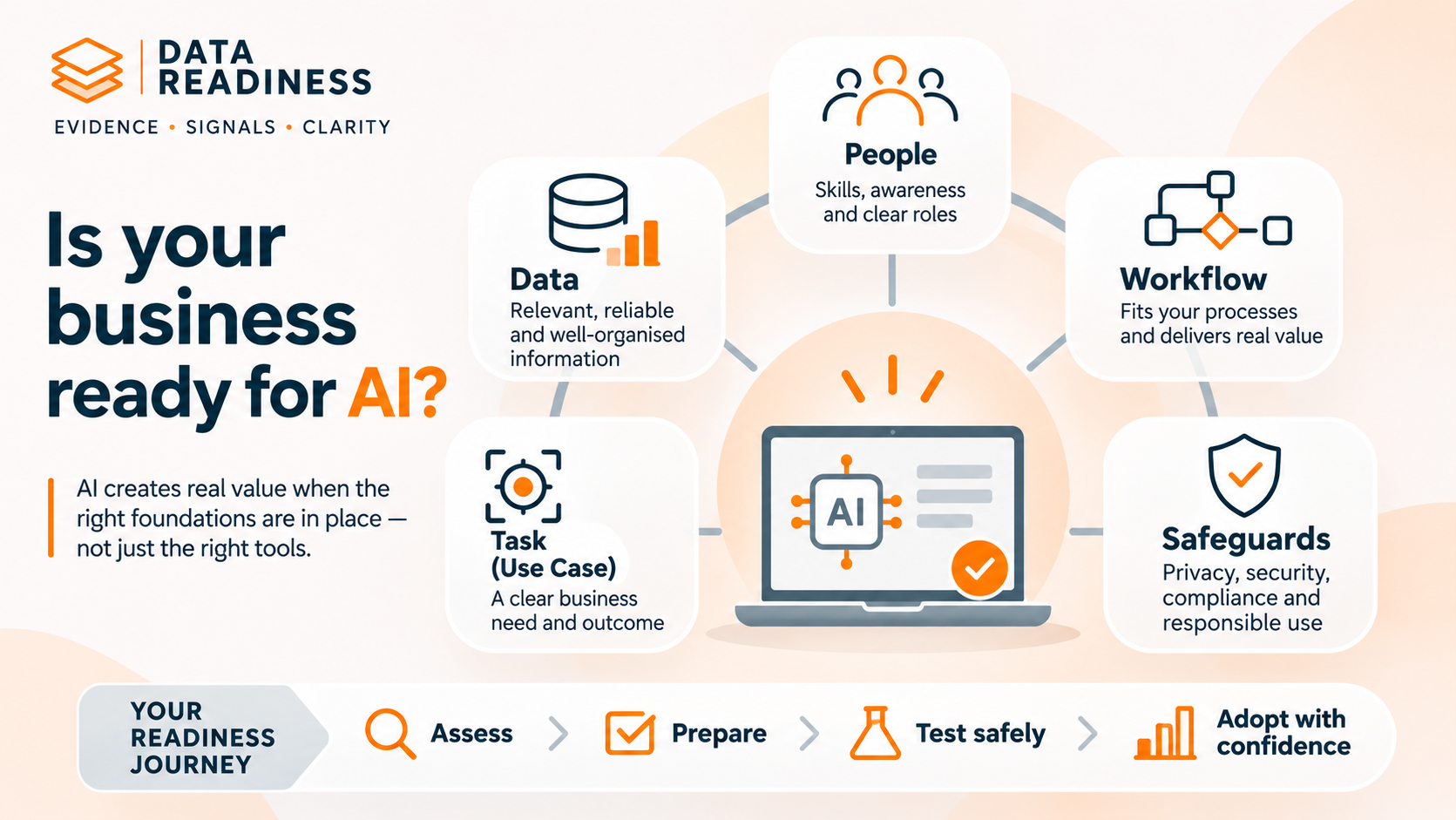
Almost every week, there is a new AI tool promising to save time, improve customer service or transform a business. It can be tempting to start with the software and work out the rest later.
But being ready for AI is not the same as being excited about it. Readiness means having a sensible task, the information and people it needs, and a way to judge whether the result is useful and safe.
You do not need to become a technology company to get value from AI. You also do not need to use AI for every problem. The best first step is often to examine the work you already do.
1. Can you name the job AI would help with?
“We want to use AI” is not a business objective. “We spend hours answering the same customer questions” is something you can investigate.
Write down one task, who does it today, how much effort it takes and what an improvement would look like. It might be drafting routine content, organising public research, checking repetitive entries or preparing a first version of a customer FAQ.
If the task is unclear, start by understanding the process. A new tool rarely fixes a poorly defined job.
2. Do you understand the information the task depends on?
AI may need examples, policies, prices, product details, instructions or customer records. Ask where that information comes from, who maintains it, whether it is current and who is allowed to share it.
Imagine a small business wants a chatbot to answer delivery questions. Its website shows one delivery fee, its order form another, and its staff follow a third rule. A chatbot cannot reliably explain a policy the business itself has not agreed on.
The first useful step might be to reconcile the delivery information, not to buy a chatbot.
Some low-risk AI uses, such as drafting copy from public product information, do not require a large internal dataset. Readiness depends on the use case, not on collecting everything.
3. Are people ready to use and check the results?
AI can be very convincing when it is wrong. Someone still needs to decide what can be delegated, what must be verified and who is accountable for the final output.
For a marketing draft, that may mean checking names, prices and claims before publication. For an operational recommendation, it may mean comparing the suggestion with records and having an authorised person approve the decision.
If staff do not know when to question a result or who makes the final call, training and a simple review process may matter more than a more powerful model.
4. Will it fit your workflow and budget?
A demonstration can look impressive but create extra work in practice. Think about what information must be entered, whether the output fits your existing systems, how often people must correct it and whether the time saved is real.
Count the whole cost: subscriptions, setup, checking, maintenance, staff time and any specialist support. Sometimes a standard form, a shared template or a basic spreadsheet process is enough.
Choose a narrow experiment with a clear before-and-after comparison. If it does not make the work better at a reasonable cost, adjust or stop.
5. Have you considered privacy, security and consequences?
Not all information belongs in a public AI service. Customer records, confidential business documents, passwords and sensitive personal information need appropriate handling and authorisation.
Check what the chosen provider does with inputs, who can access them, what it retains and whether your intended use is appropriate. Higher-impact decisions—particularly those affecting people's rights, finances, education or employment—deserve much closer scrutiny and possibly specialist review.
A small experiment using fictional or non-sensitive information is often a safer place to begin.
Three possible starting points
READY TO TEST — You have one well-defined, low-risk task, suitable information, a person who will review outputs and a modest way to measure usefulness. Start with a limited pilot and learn from the results.
PREPARE FIRST — The idea is promising, but source information conflicts, the workflow is unclear or nobody owns the review. Fix those gaps before investing further.
PAUSE AND REVIEW — The use involves sensitive information, consequential decisions, unclear permissions or significant risks. Do not proceed on enthusiasm alone; establish the safeguards and seek the right expertise.
These are practical signals, not a formal certification or universal readiness score. Different AI uses call for different levels of preparation.
Start with evidence, not excitement
AI readiness does not begin by buying an AI tool. It begins by asking what you want to achieve, what information supports the work, where the risks are and how you will know whether the outcome is better.
Evidence reveals the starting point. Signals show what may be worth testing. Clarity helps you choose the next practical step.
If that step turns out not to involve AI, it can still be exactly the right step.